
With the right reforms, India can unleash free enterprise, attract capital and accelerate growth across sectors.
The global economy is entering an era of fragmentation and strategic friction. Yesterday, President Trump announced a 25% tariff on India, along with a penalty. Despite the rhetoric, the United States and India remain close partners, with the US being one of India's most important export destinations. Whether in energy, trade, or technology, India's choices have always been shaped by national interest and developmental needs. In this context, India must remain clear-eyed: while we value deep and growing ties with the United States, we must not compromise on our strategic autonomy.
At the same time, whether or not there is a trade deal, India must fix what is within its control. We cannot integrate into global value chains unless we make our economy more competitive. This is not a moment for incremental change. It is a once-in-a-generation opportunity to rewire the Indian economy for sustained, inclusive, and innovation-led growth. To seize it, we must act with clarity, speed, and conviction, anchored in five strategic imperatives: regulatory reform, reducing the cost of borrowing, competing for global capital and talent, revitalising tourism, and allowing our cities to lead the growth narrative.
From Control to Trust
India doesn't just need better rules; we require a fundamental overhaul in our approach to regulation. The current compliance-heavy regime must be replaced with a trust-based regulatory system. Our regulators and policymakers need to adopt this mindset shift. Incorporating Regulatory Impact Assessments and expediting the restructuring of regulatory bodies will be essential.
The recently announced Jan Vishwas 2.0 bill is a step in the right direction, revisiting outdated criminalisation clauses. But deeper operational reform is essential. The National Single Window System must become the default for all business approvals. Business incorporation should auto-trigger GST, MSME, and Startup India registrations. Further, a comprehensive GST reform, including rationalisation of rates and the inclusion of petroleum, electricity, and real estate, will reduce friction and unlock business growth. To send a powerful and unequivocal signal, the labour codes, already ratified by parliament and 28 states, must be implemented immediately.
A strong partnership between the state and the private sector must drive India's growth. Across the board, we must ensure that rules are clear, consistent, and easy to follow. The state's role should be to enable, not obstruct, free enterprise. This entails building public goods, reducing bureaucratic red tape, and fostering fair competition. Whether through markets or public-private models, the goal is the same: to unlock productivity, support innovation, and expand opportunities. We have a perfect example in the case of our digital public infrastructure (DPI). Now we must build on this success by embracing the next frontier: Industry 5.0, where technology, human creativity, and sustainability converge to shape the future of manufacturing and services.
Unlock Investments
Fiscal prudence does not necessarily mean cutting spending; it also means raising revenues smartly and effectively. Direct Benefit Transfers have already curbed wasteful expenditure. Now, simplifying tax filing and improving enforcement will enhance compliance and collections. At the same time, fast-tracking disinvestment and scaling asset monetisation can unlock significant non-tax revenue (NTR) without additional borrowing. Reforms in Public Sector Enterprises (PSEs), including governance, autonomy, and accountability, can improve returns and productivity.
The Reserve Bank of India has done a phenomenal job in front-loading repo rate cuts this year. However, more needs to be done to reduce the cost of borrowing. The Statutory Liquidity Ratio (SLR) mandates banks to hold a certain percentage of their assets in government securities. This reduces the pool of available capital and increases the cost of borrowing for private enterprise. Over time, a plan should be formulated to reduce the Statutory Liquidity Ratio (SLR) for banks, thereby freeing up capital and lowering the cost of borrowing.
Equally important is a clear commitment to ramping up public infrastructure investment. India must steadily raise its infrastructure spending from the current ~3.5% of GDP to at least 4–5% over the next five years. This will not only crowd in private investment but also lower logistics costs, improve productivity, and create long-term capacity for growth.
Compete for Global Capital and Talent
Despite rising trade barriers globally, India has an opportunity to become the preferred investment destination. But to export competitively, we must also import efficiently. Our high tariffs and inconsistent Quality Control Orders (QCOs) raise input costs, penalise exporters, and deter investors. A rational, globally aligned tariff structure is vital. At the same time, India must actively diversify its export markets and product mix to reduce vulnerability to geopolitical shocks and policy unpredictability.
Press Note 3 rightly imposes safeguards on FDI from neighbouring countries, including China. But in sectors like component manufacturing, where China is deeply embedded in global value chains, strategic autonomy must allow calibrated economic engagement. We should not let security concerns prevent us from sourcing efficiently and scaling competitively.
India must also replicate the success story of mobile manufacturing across other sectors. This involves engaging directly with leading firms, providing them with plug-and-play infrastructure, and ensuring swift and certain approvals.
As Production-Linked Incentives (PLIs) approach maturity, we must shift focus from production volume to innovation, R&D, and export intensity. At the same time, India should launch a Global Research Chairs initiative, offering top global minds competitive funding, flexible appointments, and access to world-class labs. Liberal visas, diaspora engagement, and long-term fellowships will help build globally respected STEM ecosystems.
A thriving innovation ecosystem needs more than brilliant individuals. It requires the state to play an enabling role, through funding, procurement, and regulation, and for the private sector to scale ideas into impact. Without this ecosystem, breakthrough ideas rarely translate into global leadership.
Taking India Tourism to the World
India's tourism potential is extraordinary, but underleveraged. With unmatched diversity in culture, geography, and spirituality, we should rank among the world's top five destinations. Yet, we lack seamless travel experiences, world-class branding, and a strong digital presence.
We must relaunch the "Incredible India" campaign with modern storytelling, immersive content, co-branding with global festivals and sports, and strategic outreach to the diaspora. On the ground, tourism governance needs an overhaul. A unified, digital single-window system for hotel licensing, transport, and event permissions is essential. E-visas must be seamless and real-time.
Investments in heritage conservation, eco-tourism, homestays, and local guide ecosystems will generate employment across rural and semi-urban India. Tourism is not just a growth sector—it is a multiplier of soft power.
Let Cities Lead
India's cities are engines of growth—but they are choked by congestion, pollution, and poor governance. The Union Budget's announcement of a ₹1 lakh crore Urban Challenge Fund is a decisive step. It must be operationalised competitively, rewarding cities based on clean air, sustainable mobility, public transport, and green spaces.
Our municipalities must be empowered—not just as service providers but as drivers of the creative economy. From cuisine and crafts to theatre and design, cities must become magnets of culture and hubs for youth and women-led employment.
Let us remember: tourists first see India through its cities. If we want to be a global destination, our cities must first be liveable, vibrant, and clean.
A Rare Global Inflection Point
The disruptions caused by tariff wars, supply chain realignments, and geopolitical tensions have opened a window of opportunity for India to take the lead. However, true leadership will not emerge from tinkering or hesitation.
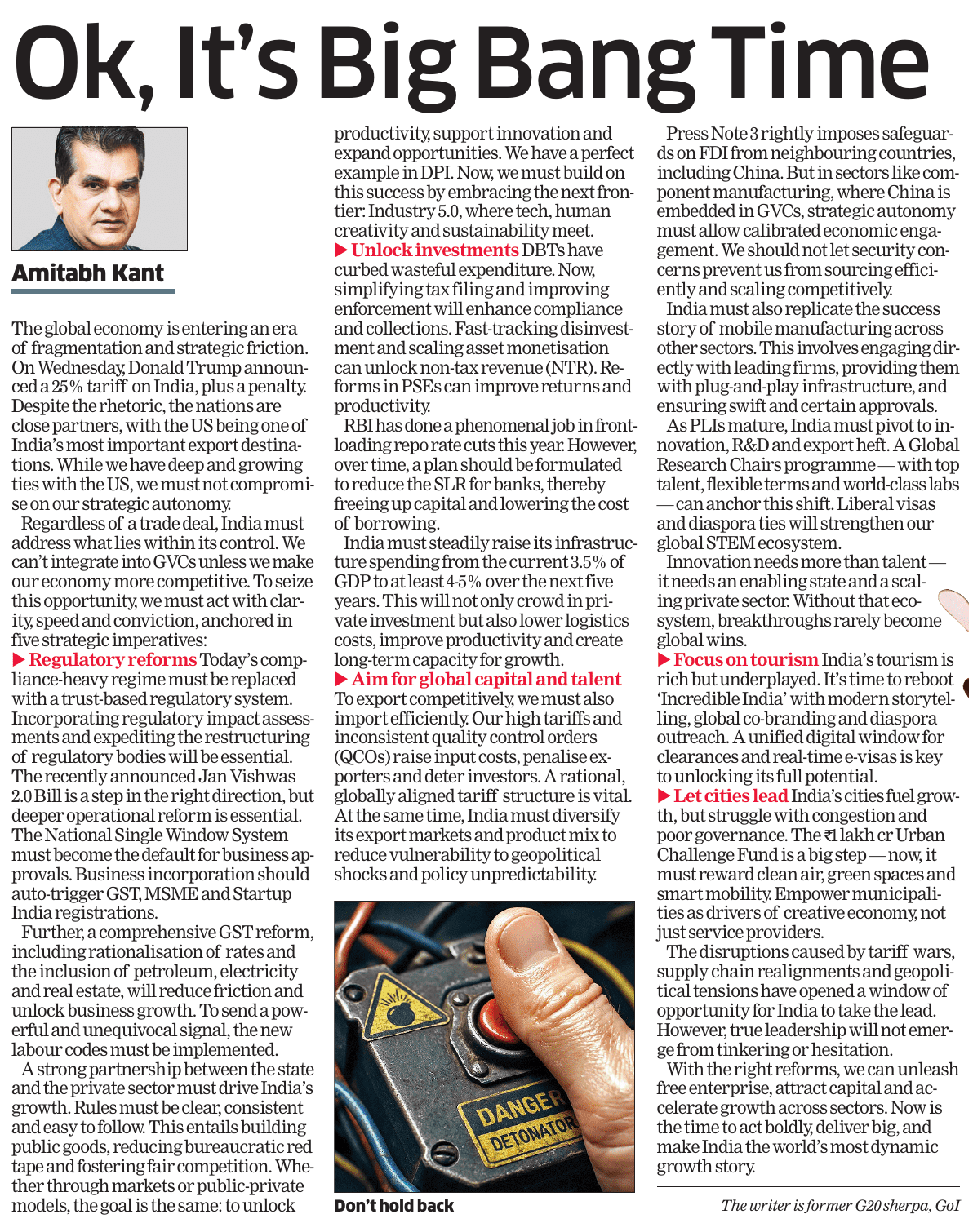
With the right reforms, we can unleash free enterprise, attract capital, and accelerate growth across sectors. This is not the time for half-measures. It is the time to act boldly, deliver big, and make India the world's most dynamic growth story. India must lead despite the Trumpian tariff disruptions.
The author is India's former G20 Sherpa and former CEO of NITI Aayog.