
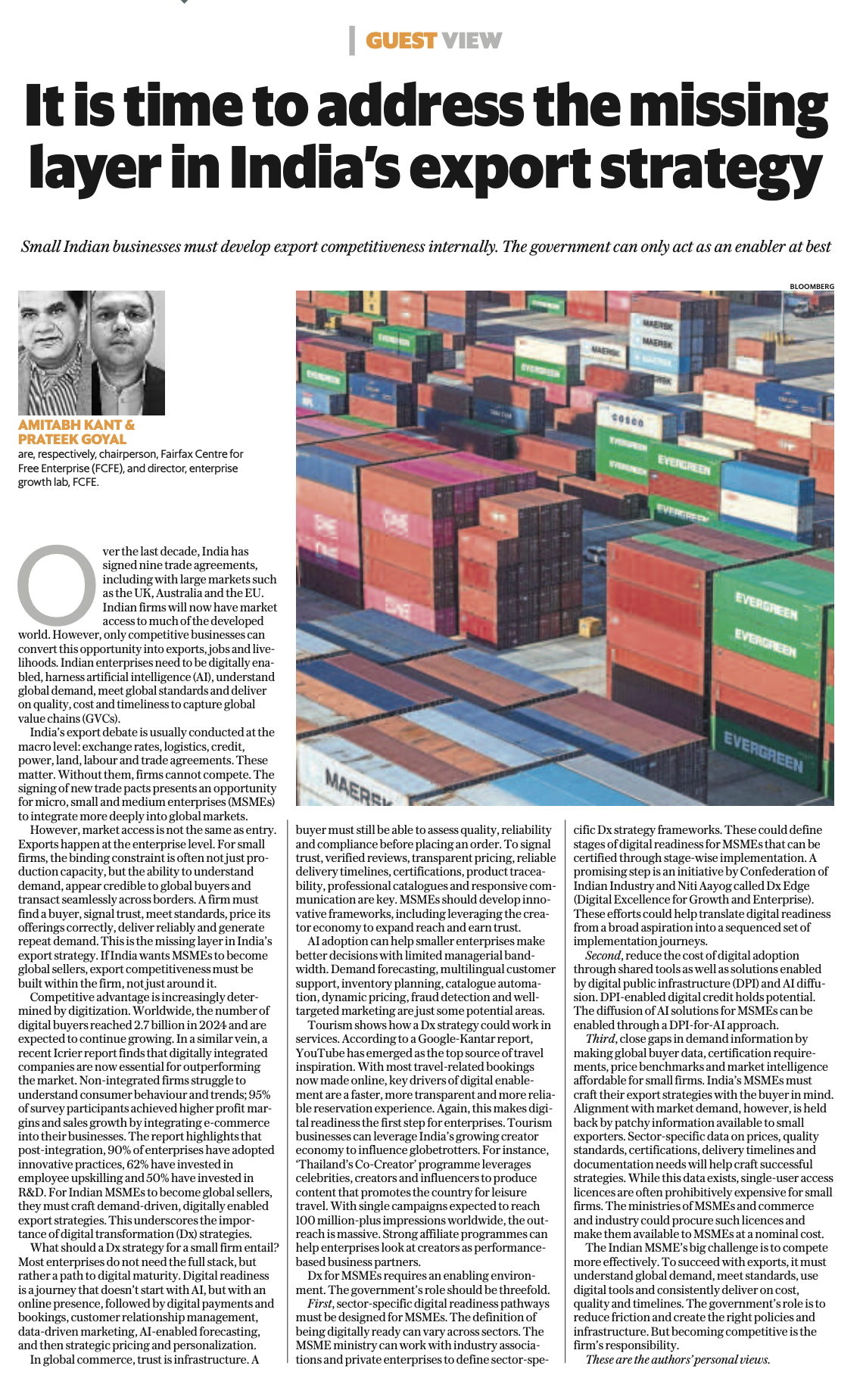
Small Indian businesses must develop export competitiveness internally. The government can only act as an enabler at best.
Amitabh Kant & Prateek Goyal are, respectively, chairperson and director at Fairfax Centre for Free Enterprise (FCFE).
Over the last decade, India has signed nine trade agreements, including with large markets such as the UK, Australia and the EU. Indian firms will now have market access to much of the developed world. However, only competitive businesses can convert this opportunity into exports, jobs and livelihoods. Indian enterprises need to be digitally enabled, harness artificial intelligence (AI), understand global demand, meet global standards and deliver on quality, cost and timeliness to capture global value chains (GVCs).
India’s export debate is usually conducted at the macro level: exchange rates, logistics, credit, power, land, labour and trade agreements. These matter. Without them, firms cannot compete. The signing of new trade pacts presents an opportunity for micro, small and medium enterprises (MSMEs) to integrate more deeply into global markets.
However, market access is not the same as entry. Exports happen at the enterprise level. For small firms, the binding constraint is often not just production capacity, but the ability to understand demand, appear credible to global buyers and transact seamlessly across borders. A firm must find a buyer, signal trust, meet standards, price its offerings correctly, deliver reliably and generate repeat demand. This is the missing layer in India’s export strategy. If India wants MSMEs to become global sellers, export competitiveness must be built within the firm, not just around it.
Competitive advantage is increasingly determined by digitization. Worldwide, the number of digital buyers reached 2.7 billion in 2024 and is expected to continue growing. In a similar vein, a recent Icrier report finds that digitally integrated companies are now essential for outperforming the market. Non-integrated firms struggle to understand consumer behaviour and trends; 95% of survey participants achieved higher profit margins and sales growth by integrating e-commerce into their businesses. The report highlights that post-integration, 90% of enterprises have adopted innovative practices, 62% have invested in employee upskilling and 50% have invested in R&D. For Indian MSMEs to become global sellers, they must craft demand-driven, digitally enabled export strategies. This underscores the importance of digital transformation (Dx) strategies.
What should a Dx strategy for a small firm entail? Most enterprises do not need the full stack, but rather a path to digital maturity. Digital readiness is a journey that doesn’t start with artificial intelligence (AI), but with an online presence, followed by digital payments and bookings, customer relationship management, data-driven marketing, AI-enabled forecasting, and then strategic pricing and personalization.
In global commerce, trust is infrastructure. A buyer must still be able to assess quality, reliability and compliance before placing an order. To signal trust, verified reviews, transparent pricing, reliable delivery timelines, certifications, product traceability, professional catalogues and responsive communication are key. MSMEs should develop innovative frameworks, including leveraging the creator economy to expand reach and earn trust.
AI adoption can help smaller enterprises make better decisions with limited managerial bandwidth. Demand forecasting, multilingual customer support, inventory planning, catalogue automation, dynamic pricing, fraud detection and well-targeted marketing are just some potential areas.
Tourism shows how a Dx strategy could work in services. According to a Google-Kantar report, YouTube has emerged as the top source of travel inspiration. With most travel-related bookings now made online, key drivers of digital enablement are a faster, more transparent and more reliable reservation experience. Again, this makes digital readiness the first step for enterprises. Tourism businesses can leverage India’s growing creator economy to influence globetrotters. For instance, ‘Thailand’s Co-Creator’ programme leverages celebrities, creators and influencers to produce content that promotes the country for leisure travel. With single campaigns expected to reach 100 million-plus impressions worldwide, the outreach is massive. Strong affiliate programmes can help enterprises look at creators as performance-based business partners.
Dx for MSMEs requires an enabling environment. The government’s role should be threefold.
First, sector-specific digital readiness pathways must be designed for MSMEs. The definition of being digitally ready can vary across sectors. The MSME ministry can work with industry associations and private enterprises to define sector-specific Dx strategy frameworks. These could define stages of digital readiness for MSMEs that can be certified through stage-wise implementation. A promising step is an initiative by Confederation of Indian Industry and Niti Aayog called Dx Edge (Digital Excellence for Growth and Enterprise). These efforts could help translate digital readiness from a broad aspiration into a sequenced set of implementation journeys.
Second, reduce the cost of digital adoption through shared tools as well as solutions enabled by digital public infrastructure (DPI) and AI diffusion. DPI-enabled digital credit holds potential. The diffusion of AI solutions for MSMEs can be enabled through a DPI-for-AI approach.
Third, close gaps in demand information by making global buyer data, certification requirements, price benchmarks and market intelligence affordable for small firms. India’s MSMEs must craft their export strategies with the buyer in mind. Alignment with market demand, however, is held back by patchy information available to small exporters. Sector-specific data on prices, quality standards, certifications, delivery timelines and documentation needs will help craft successful strategies. While this data exists, single-user access licences are often prohibitively expensive for small firms. The ministries of MSMEs and commerce and industry could procure such licences and make them available to MSMEs at a nominal cost.
The Indian MSME’s big challenge is to compete more effectively. To succeed with exports, it must understand global demand, meet standards, use digital tools and consistently deliver on cost, quality and timelines. The government’s role is to reduce friction and create the right policies and infrastructure. But becoming competitive is the firm’s responsibility.
These are the authors’ personal views.