
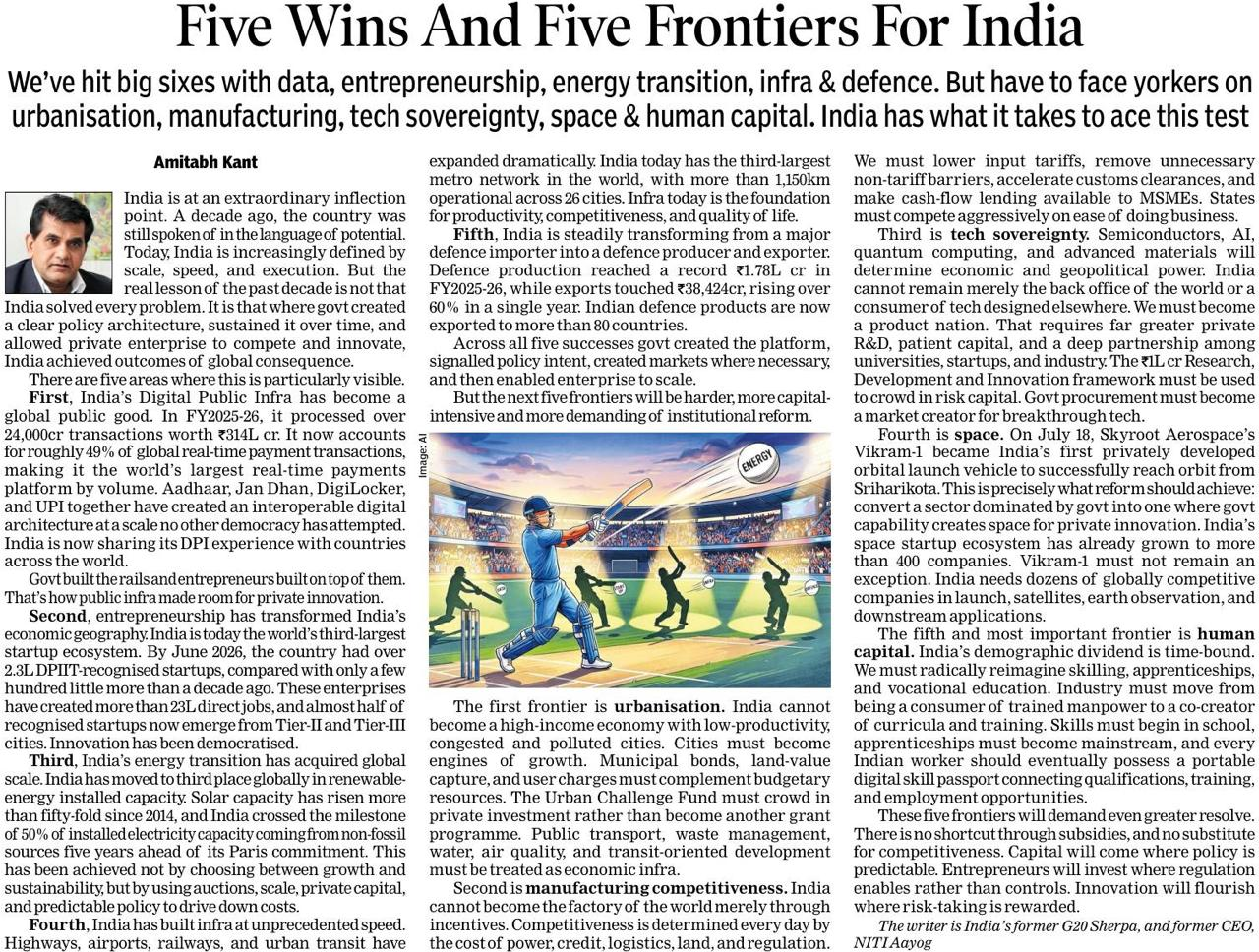
We've hit big sixes with data, entrepreneurship, energy transition, infra & defence. But have to face yorkers on urbanisation, manufacturing, tech sovereignty, space & human capital. India has what it takes to ace this test.
We've hit big sixes with data, entrepreneurship, energy transition, infra & defence. But have to face yorkers on urbanisation, manufacturing, tech sovereignty, space & human capital. India has what it takes to ace this test
Amitabh Kant
India is at an extraordinary inflexion point. A decade ago, the country was still spoken of in the language of potential. Today, India is increasingly defined by scale, speed, and execution. But the real lesson of the past decade is not that India solved every problem. It is that where govt created a clear policy architecture, sustained it over time, and allowed private enterprise to compete and innovate, India achieved outcomes of global consequence.
There are five areas where this is particularly visible.
First, India's Digital Public Infra has become a global public good. In FY2025-26, it processed over 24,000cr transactions worth ₹341L cr. It now accounts for roughly 49% of global real-time payment transactions, making it the world's largest real-time payments platform by volume. Aadhaar, Jan Dhan, DigiLocker, and UPI together have created an interoperable digital architecture at a scale no other democracy has attempted. India is now sharing its DPI experience with countries across the world.
Govt built the rails and entrepreneurs built on top of them. That's how public infra made room for private innovation.
Second, entrepreneurship has transformed India's economic geography. India is today the world's third-largest startup ecosystem. By June 2026, the country had over 2.3L DPIIT-recognised startups, compared with only a few hundred little more than a decade ago. These enterprises have created more than 23L direct jobs, and almost half of recognised startups now emerge from Tier-II and Tier-III cities. Innovation has been democratised.
Third, India's energy transition has acquired global scale. India has moved to third place globally in renewable-energy installed capacity. Solar capacity has risen more than fifty-fold since 2014, and India crossed the milestone of 50% of installed electricity capacity coming from non-fossil sources five years ahead of its Paris commitment. This has been achieved not by choosing between growth and sustainability, but by using auctions, scale, private capital, and predictable policy to drive down costs.
Fourth, India has built infra at unprecedented speed. Highways, airports, railways, and urban transit have expanded dramatically. India today has the third-largest metro network in the world, with more than 1,150kms operational across 26 cities. Infra today is the foundation for productivity, competitiveness, and quality of life.
Fifth, India is steadily transforming from a major defence importer into a defence producer and exporter. Defence production reached a record ₹1.78L cr in FY2025-26, while exports touched ₹38,424cr, rising over 60% in a single year. Indian defence products are now exported to more than 80 countries.
Across all five successes govt created the platform, signalled policy intent, created markets where necessary, and then enabled enterprise to scale.
But the next five frontiers will be harder, more capital-intensive and more demanding of institutional reform.
The first frontier is urbanisation. India cannot become a high-income economy with low-productivity, congested and polluted cities. Cities must become engines of growth. Municipal bonds, land-value capture, and user charges must complement budgetary resources. The Urban Challenge Fund must crowd in private investment rather than become another grant programme. Public transport, waste management, water, air quality, and transit-oriented development must be treated as economic infra.
Second is manufacturing competitiveness. India cannot become the factory of the world merely through incentives. Competitiveness is determined every day by the cost of power, credit, logistics, land, and regulation. We must lower input tariffs, remove unnecessary non-tariff barriers, accelerate customs clearances, and make cash-flow lending available to MSMEs. States must compete aggressively on ease of doing business.
Third is tech sovereignty. Semiconductors, AI, quantum computing, and advanced materials will determine economic and geopolitical power. India cannot remain merely the back office of the world or a consumer of tech designed elsewhere. We must become a product nation. That requires far greater private R&D, patient capital, and a deep partnership among universities, startups, and industry. The ₹1L cr Research, Development and Innovation Framework must be used to crowd in risk capital. Govt procurement must become a market creator for breakthrough tech.
Fourth is space. On July 18, Skyroot Aerospace's Vikram-1 became India's first privately developed orbital launch vehicle to successfully reach orbit from Sriharikota. This is precisely what reform should achieve: convert a sector dominated by govt into one where govt capability creates space for private innovation. India's space startup ecosystem has already grown to more than 400 companies. Vikram-1 must not remain an exception. India needs dozens of globally competitive companies in launch, satellites, earth observation, and downstream applications.
The fifth and most important frontier is human capital. India's demographic dividend is time-bound. We must radically reimagine skilling, apprenticeships, and vocational education. Industry must move from being a consumer of trained manpower to a co-creator of curricula and training. Skills must begin in school, apprenticeships must become mainstream, and every Indian worker should eventually possess a portable digital skill passport connecting qualifications, training, and employment opportunities.
These five frontiers will demand even greater resolve. There is no shortcut through subsidies, and no substitute for competitiveness. Capital will come where policy is predictable. Entrepreneurs will invest where regulation enables rather than controls. Innovation will flourish where risk-taking is rewarded.
The writer is India's former G20 Sherpa, and former CEO, NITI Aayog